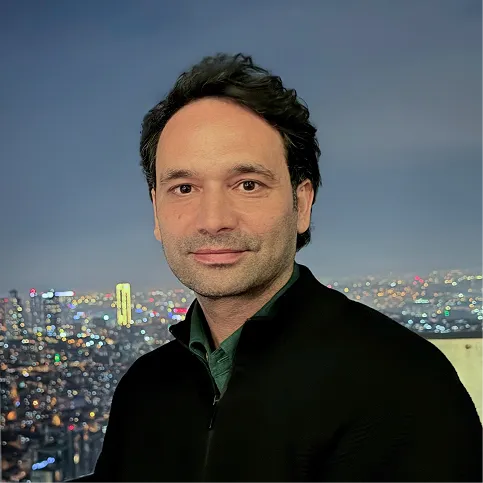
Çağrı Diner is an Associate Professor in the Department of Geophysics at Boğaziçi University’s Kandilli Observatory and Earthquake Research Institute. His research combines applied mathematics, signal processing, earthquake physics, and artificial intelligence. He leads a US$1 million Google-funded research project developing AI methods for earthquake detection, source characterization, and early warning.
Diner received his B.Sc. in Mathematics from Middle East Technical University in 2000, followed by an M.Sc. in Applied Mathematics at the same institution and a Ph.D. in Geophysics from Memorial University of Newfoundland. His doctoral research applied mathematical methods to the determination of subsurface anisotropy. He is also affiliated with Boğaziçi University’s Institute for Data Science and Artificial Intelligence (DSAI) and teaches courses on machine learning, neural networks, and AI architectures in the institute and the Department of Mathematics.
His current research focuses on developing AI methods for geophysical signal analysis and inverse problems. The Google-funded project aims to integrate newly developed earthquake detection and focal mechanism estimation tools into Kandilli Observatory’s real-time monitoring infrastructure. It also includes the development and testing of an AI-based earthquake early warning system for potential use across seismic networks throughout Türkiye.
Beyond earthquake monitoring, Diner works on incorporating AI architectures into seismic inversion methods for subsurface characterization, with applications in oil and natural gas exploration. His research has appeared in journals including Geophysics and Geophysical Prospecting. He is also co-founder and CEO of TensorBundle, an applied AI company connecting mathematical research with scientific and industrial applications.
His interest in financial research builds on methodological challenges shared by seismic and financial time series, including noise, nonstationarity, abrupt changes, and uncertainty. He seeks to adapt his expertise in signal analysis and AI to financial anomaly detection, market regime identification, time-series classification, and probabilistic forecasting. This research direction connects his experience in extracting information from complex physical signals with quantitative problems in finance.